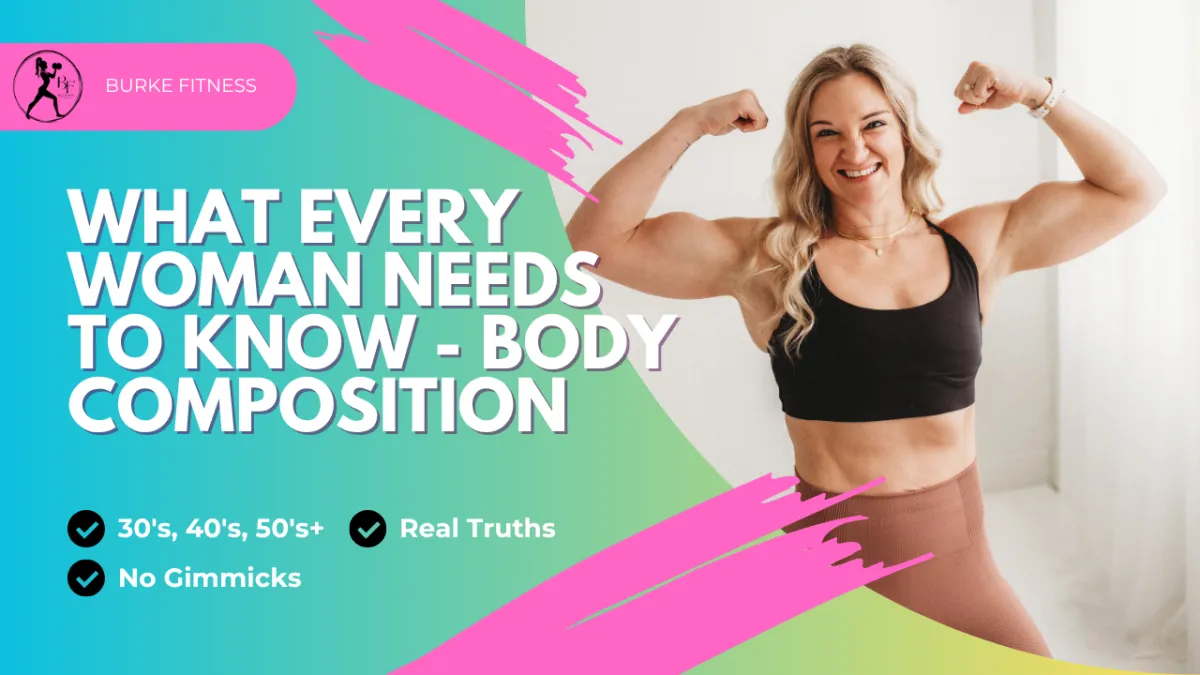
10 Things Every Woman in Her 30s, 40s & 50s Needs to Know for Body Recomposition
10 Things Every Woman in Her 30s, 40s & 50s Needs to Know for Body Recomposition
If you've ever felt like you're doing everything right — eating well, working out consistently, staying active — and still not seeing the results you want, this is for you.
The truth is, what worked in your 20s doesn't work anymore. Your hormones have changed. Your metabolism has changed. Your body needs a completely different approach — and nobody told us that.
Here are the 10 things every woman in her 30s, 40s, and 50s needs to know if she finally wants to see real body recomposition — that's fat loss and muscle gain at the same time — and build lasting health for the long haul.

1. Strength Training Is Non-Negotiable
If there's one thing I will never stop saying, it's this: cardio burns calories while you're doing it. Muscle burns calories 24/7 — even while you sleep.
Muscle is your metabolism. Cardio has its place — it's incredibly beneficial for your cardiac health, your mental health, and your overall wellbeing. But cardio alone is not going to change your shape or build the body you want. Muscle does that. Muscle is what gives you shape, definition, and the metabolic engine to keep burning fat even at rest.
Here's what most people don't know: muscle is also a hormone factory. When you strength train, your muscles release powerful chemical messengers called myokines. These help regulate inflammation, metabolism, brain health, mood, and even fat burning. The more muscle you build, the better your body handles stress and the more hormonally efficient it becomes.
Fat tissue stores hormones. Muscle helps balance them. As we move into different phases of life, muscle becomes the most important tool we have for hormonal health, insulin sensitivity, thyroid support, and progesterone balance.
If your body isn't changing, ask yourself three questions: Am I lifting heavy enough? Am I consistent enough? Am I progressively overloading — increasing my weights, reps, or sets over time so my body continues to adapt?
The bottom line: We used to be able to diet our way to results. Now we have to train our way there. Strength training three days a week is your foundation. Everything else builds on top of it.
2. Protein Is Your Best Friend
If I could fix one thing for most women besides getting them strength training, it would be their protein intake.
Most women are eating 40-60 grams of protein a day. You need more than double that.
Protein keeps you full. It stabilizes your blood sugar. It helps your muscles recover and literally builds your shape. Without adequate protein, you will lose muscle while trying to lose fat — and that is the absolute opposite of what we want.
Research shows that 0.8 to 1 gram of protein per pound of your goal body weight is the target. So if your goal weight is 150 pounds, you're aiming for 120-150 grams of protein per day. I recommend erring on the higher end — up to 1.5 grams per pound on some days — so that on your lower days you're still in a solid range.
Here's something critical that most people miss: you cannot store protein. Your body doesn't have a reserve tank. If you miss your protein goal on Monday and try to double up on Tuesday, it doesn't work that way. You're either hitting it or you're not — every single day.
Practical starting point: Aim for 35-50 grams of protein per meal. Start your day with protein within 30 minutes of waking up to offset your morning cortisol spike, stabilize blood sugar, and reduce cravings throughout the day.
3. Stop Starving Yourself
You are not stuck because your metabolism is broken. You are stuck because your body is protecting you.
1,200 calories might have worked at 25. But your body has adapted. It has learned to survive on less — and survival mode is not where results happen. Your body is doing exactly what it was designed to do: protect you. But I'm not here to help you survive. I'm here to help you thrive.
When you're chronically undereating, your body triggers a stress response. Cortisol rises. Fat storage increases. Muscle breaks down. Everything slows — your metabolism, your hormones, your results.
If you have been stuck in a low-calorie loop for years, what you need is a reverse diet — a methodical, intentional process of increasing your calories over time to rebuild your metabolism, restore your hormones, and give your body the fuel it needs to actually build muscle, support sleep, and function the way it was designed to.
The bottom line: Eat to fuel your workouts. Eat to fuel your recovery. Eat to fuel your hormones. This is not punishment. This is giving life back to the functions of your body that it is desperately trying to do.
4. Sleep Is Your Most Underrated Fat Loss Tool
If you are not sleeping, you are not recovering. And if you're not recovering, you're not changing.
Lack of sleep increases your hunger hormones and decreases your satiety hormones — meaning you stay hungry and never feel full. It makes your body crave quick carbs and sugar because your biology is screaming for fast energy. Willpower drops significantly when you're sleep deprived. This isn't a character flaw. It's your biology.
5-6 hours of sleep raises cortisol by 25%, drops estrogen and progesterone, spikes cravings by 30-50%, and locks belly fat in place.
Practical tips:
Start your wind-down 9 hours before you need to wake up — if you wake up at 6am, start winding down at 9pm
Keep your room cool and dark
Phone out of the bedroom 30 minutes before bed
Stop eating 2-3 hours before bed so your body can redirect energy from digestion to recovery
Consider magnesium glycinate 400mg before bed to support sleep quality
5. Manage Stress Like It's Your Job
You cannot burn fat if your body thinks it's running from a bear.
Our stress response was designed for genuine physical danger. But our bodies can't tell the difference between a bear and a stressful email from your boss. Cortisol spikes either way — and chronic elevated cortisol leads to water retention, cravings, and belly fat storage.
Here's the part most people don't talk about: overtraining is a stress on the body too. Exercise is a good stress in appropriate doses. It signals your body to adapt and grow. But when you cross into overtraining — working out six or seven days a week without adequate recovery — it becomes detrimental to your hormones, your sleep, and your results.
More is not always better. Recovery is part of the process. Rest days are not optional. Restorative walks, boundaries, and intentional downtime are part of your training plan.
6. Hydration + Electrolytes Matter More Than You Think
Dehydration feels like hunger. Before you reach for a snack, drink water first.
Water has a function in every single cell in your body. It's critical for digestion, muscle recovery, brain function, and fat metabolism. If you're training hard and sweating, you're also losing sodium and electrolytes that need to be replaced.
Target: 100 ounces of water per day. If you're training intensely or in hot weather, add electrolytes to your routine.
7. Track Metrics, Not Emotions
Your body is a mystery — but data is not.
The scale can lie. Water retention, hormonal fluctuations, muscle gain, and inflammation can all make the scale go up even when you're making incredible progress. If you're only measuring success by the number on the scale, you're missing the full picture.
Instead track:
Measurements (waist, hips, arms, thighs)
Weekly progress photos
Strength gains — are you lifting heavier than last month?
Energy levels
Sleep quality
Recovery
These metrics tell the real story. This is why weekly check-ins and assessments matter — because what we can measure, we can manage.
8. Daily Movement Adds Up More Than You Think
You cannot sit all day and expect one workout to fix it.
NEAT — Non-Exercise Activity Thermogenesis — is the movement you do outside of formal workouts. Getting up to switch the laundry. Walking to get the mail. Taking the stairs. This daily movement can burn more calories than your workouts combined because it keeps your body active and your metabolism humming throughout the entire day.
NEAT also helps keep blood sugar stable, supports digestion, and reduces stress.
Target: 7,000-10,000 steps per day. On rest days, bump it up to 10,000-12,000. If you don't have 30 minutes for a walk, do 10 minutes after every meal or 5 minutes every hour. It adds up.
9. Consistency Beats Motivation Every Single Time
Motivation is a feeling. It comes and goes. You cannot build a body — or a life — on a feeling.
What you build instead is discipline. Consistency. A lifestyle. You think about the person you want to become and what she does every single day — and then you take those habits and show up for them whether you feel like it or not.
You're not always going to feel like working out. That's completely normal. I don't feel like it every day either. But we show up. Even at 60%. Even at 30%. Because doing something always beats doing nothing — and that habit, repeated over time, is what changes your life.
The all-or-nothing mindset is one of the biggest things that keeps women stuck. You don't have to be perfect. You just have to be consistent. A 20-minute walk counts. A shortened workout counts. Showing up at 30% and giving 100% of that 30% counts.
10. This Is a Lifestyle, Not a Sprint
You are not just building a body. You are building your life.
Body recomposition takes months — sometimes years — not weeks. There is no shortcut. There is no quick fix. And honestly? You don't want one. Because quick fixes don't last and you've already been down that road.
What lasts is a lifestyle you can sustain. Habits you can see yourself doing a year from now. Choices that don't feel like punishment but feel like who you are.
We are playing the long game here. We are choosing strength over shrinking. We are building something that will serve us for the next 40 years — stronger bones, better hormones, more energy, sharper minds, and bodies that feel as good as they look.
Ready to stop guessing and start building?
This is exactly what I do with my 1:1 clients and inside the Burke Babes community. If you're ready to stop spinning your wheels and start seeing real results — I'd love to work with you.
👉 Book a discovery call
👉 Join Burke Babes — free
👉 See all coaching options
Allie Burke is a pre/postnatal personal trainer, nutrition and menopause coach based in Mt. Juliet, TN. She is the founder of Burke Fitness and the Burke Babes community.


